
The Disparity Among a Numeral and a Life
From Numbers to Lives: Why Somalia Needs a Stronger Evidence Architecture for Health
The Disparity Among a Numeral and a Life is a timely and strategic reflection on one of the most important questions facing Somalia’s health system: how can health data move beyond reporting and become a force for better decisions, stronger institutions, and improved lives?
The paper argues that Somalia’s challenge is not simply the absence of health data. Rather, the deeper issue lies in the gaps between data generation, validation, interpretation, policy decision-making, implementation, and institutional learning. Without a system that connects these stages, even the most promising statistics may fail to guide timely and equitable action.
When a Statistic Becomes a Decision
The paper uses the example of potentially unreliable maternal-health data to show how a single indicator can shape life-affecting decisions. Questions about midwife deployment, emergency obstetric supplies, health financing, and service prioritisation may all depend on whether an indicator is accurate, traceable, and properly interpreted. In this sense, the distance between an inaccurate number and a preventable death is not merely a statistical problem; it is an institutional one.
Five Leadership Priorities for Evidence-Informed Health Systems
- Treat research as stewardship: Health research should be governed with the same seriousness as financial accountability because it shapes public priorities, investments, and services.
- Build evidence-support systems: Research must be found, appraised, synthesised, contextualised, and translated into products that leaders can use for real decisions.
- Make data quality a leadership responsibility: Reliable indicators require clear definitions, accountable custodianship, denominator governance, verification, feedback, and appropriate incentives.
- Recognise evidence sovereignty: National authority over data, methods, analysis, and interpretation is central to health sovereignty and institutional independence.
- Prioritise practical instruments: Aspirational commitments must be matched with ownership, timelines, protocols, measurable outcomes, and implementation accountability.
A National Evidence Architecture for Somalia
The paper proposes an integrated framework built around three mutually reinforcing systems. First, a research system should generate relevant and credible knowledge. Second, an evidence-support system should synthesise and contextualise that knowledge for specific decisions. Third, an evidence-implementation system should ensure that decisions are translated into improved practice, monitored outcomes, and continuous institutional learning.
The Evidence-to-Impact Cascade
One of the paper’s most useful contributions is the Evidence-to-Impact Cascade, which follows evidence through seven stages: generated, trusted, synthesised, contextualised, considered, decided, and delivered. At each stage, evidence can be weakened by poor reporting, weak verification, fragmented analysis, delayed communication, political incentives, or limited implementation support. The model therefore reminds leaders that producing data is only the beginning; the real test is whether evidence survives the journey into action.
Purpose, Audience, and Policy Relevance
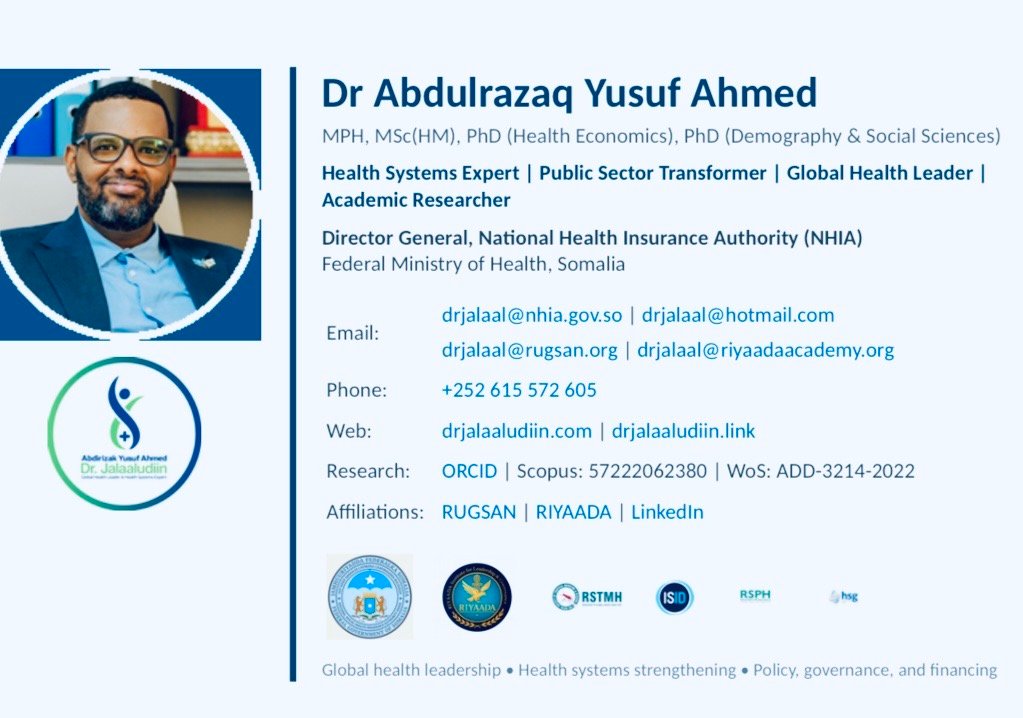
Authored by Dr Abdulrazaq Yusuf Ahmed, the paper is designed for government leaders, ministries of health, the National Institute of Health, Federal Member States, universities, research institutions, health-financing authorities, development partners, public-health practitioners, policymakers, data managers, and civil-society organisations. Its primary purpose is to provide a strategic framework for strengthening Somalia’s capacity to produce, govern, interpret, translate, and apply health evidence in policy and operational decision-making.
The paper speaks directly to practical policy questions: Who owns national health indicators? How should uncertainty be reported? How can research priorities be connected to real policy choices? How can Somalia retain value from externally supported research? And how can institutions measure whether evidence has changed decisions, implementation, and outcomes?
From Proposals to Institutional Practice
Among its principal proposals, the paper calls for an NIH-led National Health Research and Evidence Council, a national Knowledge Translation Platform, a rapid evidence-response service, a governed national research repository, and a ring-fenced domestic health-research fund. It also recommends integrating data-quality requirements into health information systems, supervision structures, partnership agreements, and performance reviews.
Success, in this framework, is measured by whether major policy decisions are supported by documented evidence, whether priority questions receive timely responses, whether Somali scientific leadership is strengthened, whether routine data become more complete and reliable, and whether evidence-informed decisions are translated into implementation plans, supervision arrangements, learning indicators, and formal review points.
Why This Matters
The core message is powerful: a health statistic should never be treated as an isolated number. Every figure may influence financing, workforce deployment, procurement, service coverage, and ultimately human survival. Leadership must therefore ensure that each material figure is traceable, verified, contextualised, ethically governed, communicated in time, and connected to accountable action.
Ultimately, The Disparity Among a Numeral and a Life is both a policy argument and a leadership call. It urges Somalia to build institutions that do more than collect information; they must protect the integrity of evidence, translate knowledge into decisions, and ensure that those decisions improve the lives of the people they are meant to serve.
✍️: Dr Abdulrazaq Yusuf Ahmed ; Dr Jalaaludiin
Please Read the attached document to ensure a comprehensive understanding of its contents.
Published by RIYAADA Institute for Leadership & Governance ·
ISNI 0000 0005 3005 9908 · Ringgold ID 847744
Journal ISSN 3136-1943 applies to RIYAADA’s serial scholarly publication,
not to this web blog post.
Share this Article
Help others discover this article by sharing it with your professional network.